
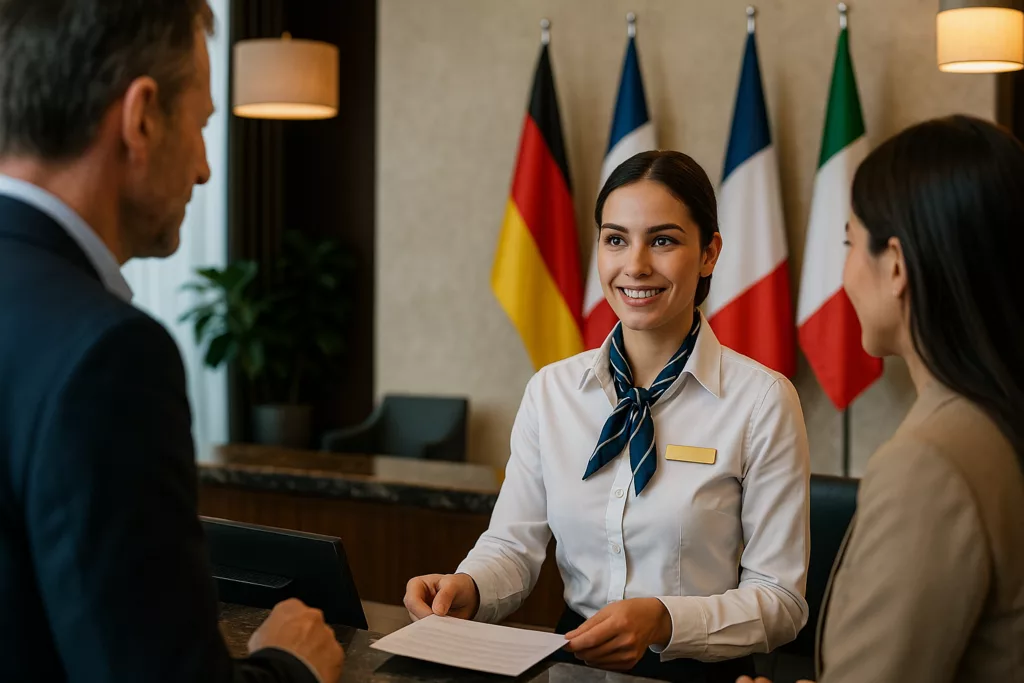
Why European hotels increasingly rely on Spanish staff in 2026
European hotels are turning to Spanish staff in 2026 to close persistent labour gaps and protect service quality in peak seasons. With EU mobility, strong hospitality training and multilingual talent, Spain has become a reliable source for front- and back-of-house roles across France, Italy, Germany and the Netherlands.
What is driving the shift towards Spanish staff?
Hotels across Western Europe are rebuilding teams amid sustained travel demand and wage inflation. Candidate pipelines remain thin locally, especially for housekeeping, F&B and reception roles. Spanish staff help bridge these shortages thanks to mobility within the EU, competitive expectations and a steady output of hospitality graduates and experienced seasonal workers.
- Depth of talent pool: Spain’s vocational schools and resort economy produce seasoned candidates for reception, F&B, housekeeping and kitchen roles, used to high guest volumes and fast turnarounds.
- Language coverage: Many Spanish candidates offer English at B1–B2 and a second language (French, Italian, German or Portuguese), matching urban and resort hotel needs.
- Seasonal complementarity: Spanish coastal seasons often offset Central/Northern European peaks, enabling back-to-back contracts without long gaps.
- EU mobility and recognition: No work permit is required within the EU/EEA for Spanish citizens, and most hospitality roles rely on skills readily transferable across borders.
- Service culture fit: Training emphasises guest relations, teamwork and resilience — valuable in city hotels and leisure destinations alike.
For GMs and HR leaders, the key benefit is predictability: Spanish pipelines can shorten time-to-hire and stabilise rota planning, especially when coordinated across multiple properties in a group.
How European hotels can structure hiring from Spain in 2026
To capture the advantages of Spanish staff in European hotels, build a structured, compliance-led hiring funnel. The steps below reflect common practices across EU operators and specialist agencies.
- Define role clusters and intake windows: Group roles with similar profiles (e.g., housekeeping + public areas; reception + concierge) and set intake dates 8–12 weeks before peak.
- Source multi-channel: Combine referrals, vetted agencies, EURES and targeted school partnerships. Use short skills assessments and language checks aligned to service standards (e.g., B1 for housekeeping guest interactions; B2 for reception).
- Offer clear contracts: Prefer local contracts in the host country for simplicity. If posting staff temporarily, ensure A1 certificates and respect local pay, allowances and working-time rules.
- Onboarding and accommodation: Arrange shared housing or negotiate local partnerships early. Provide a 3–5 day induction on SOPs, PMS basics, upselling and health & safety.
- Rota and progression: Stabilise weekends and night shifts via premiums; map progression (e.g., Room Attendant → Supervisor in 6–12 months) to boost retention.
- Language and guest journey: Pair new joiners with bilingual buddies for the first two weeks; standardise service phrases by department to accelerate confidence.
- Data and compliance: Track time-to-fill, first-90-day retention and guest NPS by cohort. Maintain auditable files for right to work, qualifications and training.
Where groups operate in multiple markets, centralise sourcing and pre-boarding in Spain, then allocate cohorts to properties based on language mix and seasonality. This reduces fragmentation and improves offer-acceptance rates.
| Hiring route | From Spain (EU citizens) | Domestic only |
|---|---|---|
| Time-to-fill | Typically 20–35 days (indicative) | Varies; often longer in peak cities |
| Language coverage | English B1–B2; often French/Italian/German | Depends on city; less multi-language outside hubs |
| Admin complexity | Low (EU right to work); post if needed with A1 | Low (local contracts) |
| Peak-season availability | High if planned early; strong seasonal cohorts | Constrained; strong local competition |
| Cost predictability | Good with cohort planning and housing blocks | Variable; higher last‑minute premiums |
Do Spanish citizens need work permits elsewhere in the EU?
Are Spanish hospitality qualifications recognised?
How should hotels manage language gaps on reception or F&B?
Is posting staff from Spain preferable to local contracts?
Sources
- Eurostat – Labour mobility in the EU
- EURES – Labour shortages and surpluses in Europe
- HOTREC – Employment and social affairs in hospitality
- WTTC – Europe Economic Impact
- European Commission – Posting of workers
Figures and ranges herein are indicative, compiled from industry practice, public guidance and agency experience; they are not official statistics.
Accelerate your hiring, without compromise
Describe your need, urgency and volume.
We will respond with a clear, actionable plan.